Managing irrigation demand is a balancing act between meeting crop needs and staying within legal diversion limits. When multiple crops share a single diversion point, "peak demand" can quickly lead to compliance issues.
In this walkthrough, we look at how to use the IAMDD (Integrated Agricultural and Municipal Demand-Delivery) framework to audit water rights and implement rotation logic to stay within instantaneous flow limits.
The Challenge: Multi-Crop Demand vs. Tiered Rights
In our hypothetical scenario, we are managing 210 acres divided between two high-value crops: * 110 acres of Walnuts (Subsurface Drip) * 99 acres of Tomatoes (Wheel Line)
These crops draw from a single pond governed by two distinct water rights: 1. Senior Right (WR1): 1,200 GPM limit / 450 acre-feet annual allotment. 2. Junior Right (WR2): 1,000 GPM limit / 350 acre-feet annual allotment.
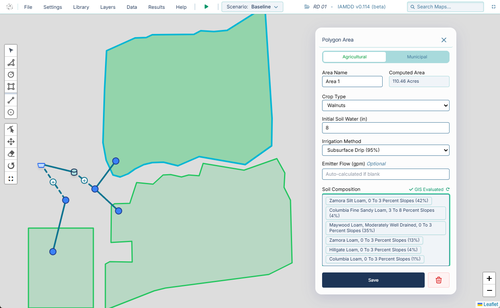
Identifying the Peak Flow Violation
By default, the model prioritizes soil moisture—delivering water whenever the soil drops toward the wilting point. Without coordination, the walnuts and tomatoes may irrigate simultaneously.
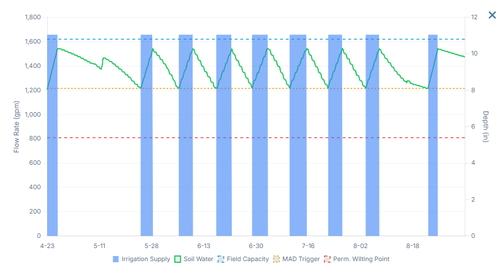
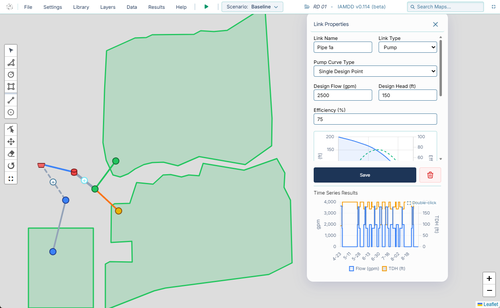
When we enable Water Rights Tracking at the point of diversion, the model provides a clear accounting of compliance. In this "unmanaged" state, the combined instantaneous demand often spikes above the total 2,200 GPM limit.
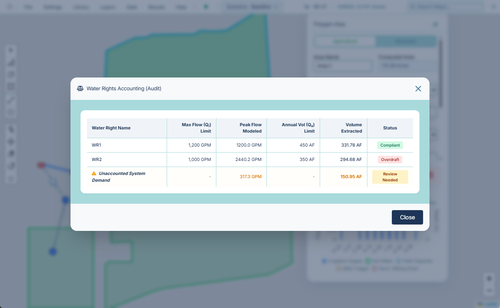
The Solution: Implementing Rotation Scheduling
To fix this, we don't necessarily need more water; we need better timing. IAMDD allows us to define Delivery Schedules—in this case, 150-hour blocks on a 14-day rotation.
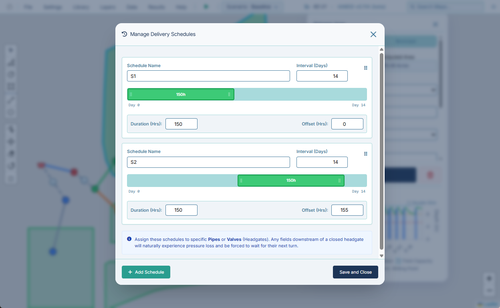
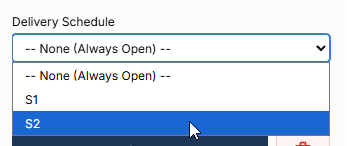
By assigning the walnuts to Schedule 1 and the tomatoes to Schedule 2, we "shave the peaks" of our demand curve:
- Define the Library: Create staggered rotation intervals in the Delivery Schedules menu.
- Assign the Pipes: Link specific delivery lines to the new schedules.
- Verify: Re-run the simulation to ensure soil moisture remains healthy while flow stays compliant.
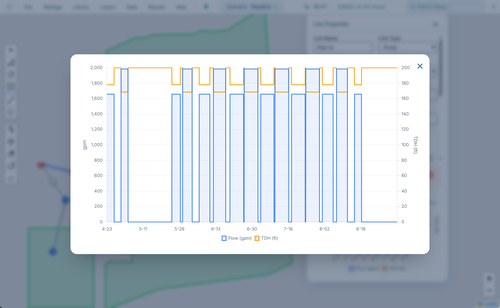
Results: Compliance Without Crop Stress
After implementing the rotation, the results show that the pump flow never exceeds the 2,000 GPM mark. More importantly, the soil water depth plots confirm that both the walnuts and tomatoes stay well within their target moisture zones—staying above the wilting point and below field capacity.
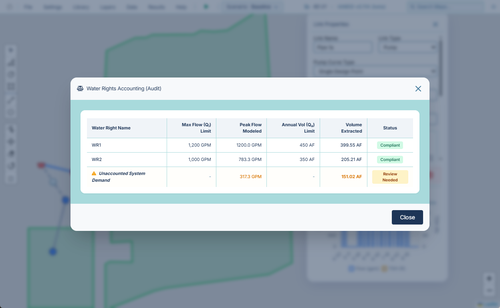
Using this approach allows irrigation consultants and managers to test operational changes in a risk-free environment before implementing them in the field.
To explore this model yourself or learn more about the IAMDD framework, visit lillywhitewater.com.